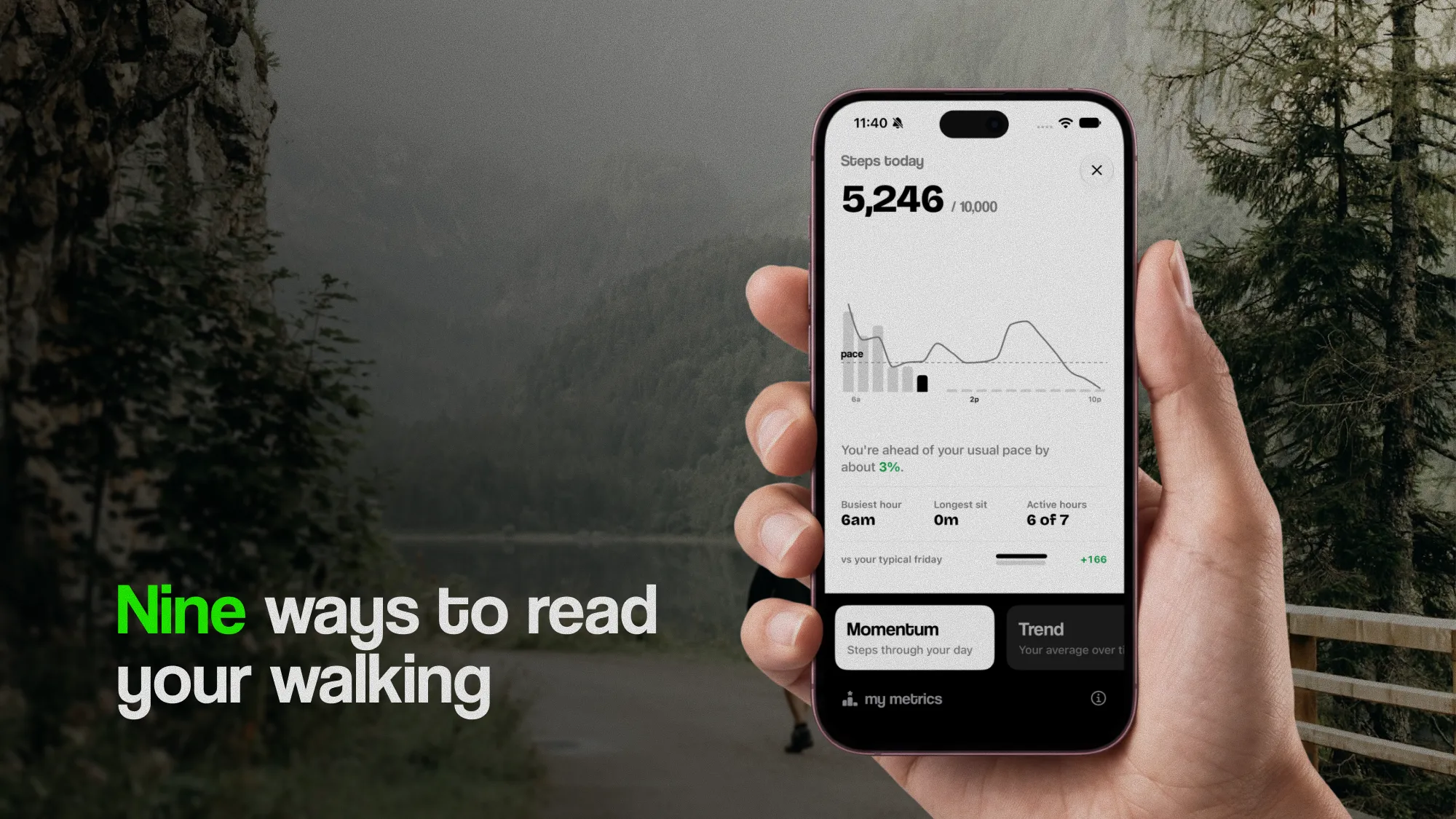

Today's step count is noisy. A trip to the shops, a rainy afternoon or a long drive can double it or halve it. That makes a single day a poor answer to the question most people actually have: am I walking more than I used to? Trend answers that question.
What does Trend measure?
Trend tracks your average daily steps over time and shows whether it's rising, falling or holding steady. Instead of reacting to every high and low day, it follows the direction your walking is moving in over weeks and months.
Why use an average instead of a single day?
Because days vary far more than habits do. Most people's weeks have a rhythm: busy weekdays, freer weekends, the odd day of travel or illness. A rolling average absorbs those swings, so a real change stands out from the noise.
Think of it like weighing yourself. One morning's number tells you little. The direction over a month tells you a lot.
Why does the direction matter?
Large studies of step counts and health keep finding the same shape: the more you walk, the lower your risk, with the biggest gains at the lower end.
- Paluch et al., 2022. Fifteen studies of nearly 50,000 adults found the risk of dying early kept falling as daily steps rose, until about 6,000–8,000 steps for people 60 and over and 8,000–10,000 for people under 60.
- Ding et al., 2025. A review of 57 studies linked 7,000 steps a day, compared with 2,000, to a 47% lower risk of death and a 38% lower risk of dementia.
Neither study looked at trends directly, and both are observational. But they suggest that moving your average up, especially from a low starting point, is one of the most worthwhile things a walker can do.
What's a good Trend?
- Below your target: a gentle rise. About 10% a week is a sensible ceiling: from 4,000 steps a day, that's 7,000 in six weeks.
- At your target: flat is good. Holding a healthy average through busy and quiet weeks is the goal.
- Falling: worth noticing, not worrying about. A dip after illness, travel or a busy month is normal. Several weeks of decline is a sign to look at your routine.
How can you move your Trend up?
- Raise your floor, not your peak. Lifting your quietest days is easier to keep up than chasing the occasional huge one.
- Add one fixed walk. The same time each day is easier to keep than good intentions.
- Raise your goal slowly. About 10% a week keeps the trend climbing without burning out.
- Look weekly, not daily. Check Trend once a week and decide one small change for the next.
Trend in StepUp
StepUp reads your daily steps from Apple Health, works out your average over time and shows whether it's going up or down, with a short note on what's changed. It needs only your iPhone. Trend is part of StepUp Pro, and like every metric it's calculated and stored on your iPhone.
StepUp's walking plan uses the same idea: it raises your target by no more than 10% a week, so your trend climbs steadily. How many steps should I walk a day? covers where to aim.
The short version
- Trend shows whether your average daily steps are rising or falling.
- A single day is noisy. The average over weeks is what tells you if you're walking more.
- Raising your average, especially from a low start, is linked to lower risk of early death and dementia.
- A rise of about 10% a week is plenty. Once you're at your target, flat is fine.
Questions
Why did my step trend go down?
Usually because of a run of quieter days: illness, travel, bad weather or a busy stretch at work. A short dip is normal. If your trend falls for several weeks, look at which days changed and add one fixed walk to them.
How fast should I increase my steps?
About 10% a week is a sensible limit. From 4,000 steps a day, that reaches 7,000 in about six weeks, without any single week being a big jump.
Is a flat step trend bad?
No. If you're already at a healthy average, keeping it steady is the goal. A flat trend below your target just means it's time to add a little each week.
Does Trend need an Apple Watch?
No. Trend uses the daily step counts your iPhone saves to Apple Health. An Apple Watch can make the counts more complete, but it isn't needed.
Sources
Written by Dheeraj Kumar Sharma, who makes StepUp. How the guides are written.