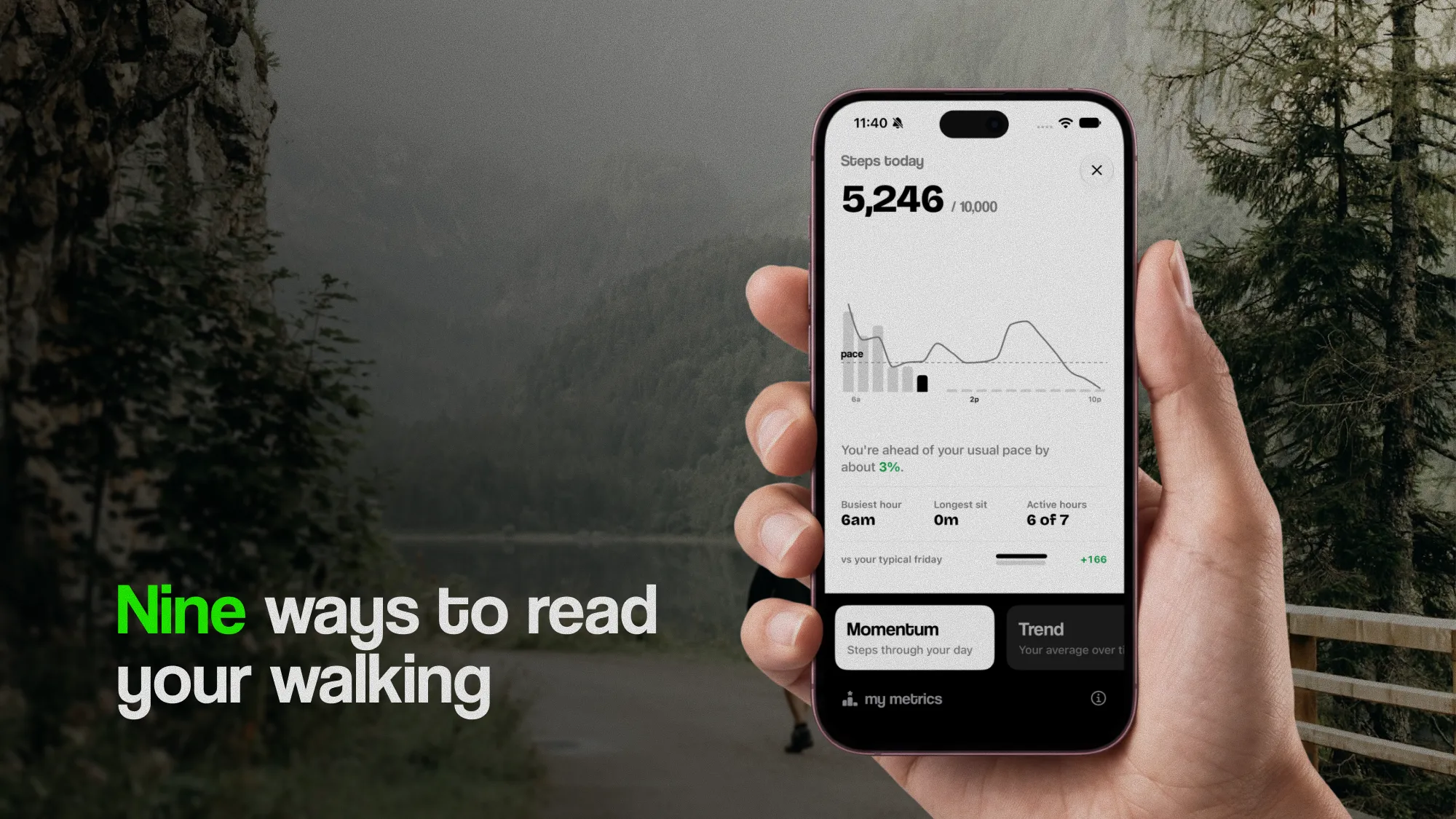

When you walk, your left and right steps should take about the same time. After a sprained ankle, a sore knee or a long day on your feet, they often don't, and you start to favour one side. You might not notice. Your iPhone often does. Evenness shows what it sees.
What does Evenness measure?
Evenness uses two of the walking measurements your iPhone records in Apple Health:
- Walking asymmetry: the share of your steps where one foot moves faster or slower than the other. Lower is more even.
- Double support time: the share of each step when both feet are on the ground at once. It rises when you walk more cautiously, for example on ice, when tired, or when your balance is less sure.
How does your iPhone measure this?
Since iOS 14, iPhone 8 and later models estimate these measurements using the motion sensors while the phone is in a trouser pocket or held near your waist, as you walk on flat ground. They're recorded automatically in the background. No Apple Watch is needed, and a watch doesn't measure them.
Apple published a white paper describing how these "mobility metrics" were developed and checked against lab equipment. Independent testing has found the iPhone measures walking speed and step length well, but may read double support and asymmetry a little low, so trends over time are more reliable than any single value.
What's a normal walking asymmetry?
For most healthy people, walking asymmetry is low: the vast majority of steps are even. Occasional uneven days are normal after a long walk or in awkward shoes.
What matters most is a change from your usual: asymmetry that rises and stays up, or double support that creeps higher over weeks.
Why does it matter?
Uneven walking often follows an injury or pain, as you shift weight off a sore side. Apple's research notes that poorer coordination between the legs, and more time on both feet, are linked to a higher risk of falling, particularly in older adults.
Evenness is a guide, not a diagnosis. It can't tell you why your walking has changed. If it rises without an obvious reason, or you feel less steady, talk to a doctor or physiotherapist.
What affects your Evenness?
- Injury and pain, such as a sprained ankle, sore knee or hip, or back pain.
- Footwear, especially new shoes, heels or one shoe rubbing.
- Carrying things: a heavy bag on one shoulder, or a child on one hip.
- Where the phone sits: readings work best with the phone snug in a trouser pocket.
- Tiredness, which tends to raise double support time.
Evenness in StepUp
StepUp reads walking asymmetry and double support from Apple Health and shows how even your walking is from week to week, with a short note on what the numbers mean. It needs only your iPhone. Evenness is part of StepUp Pro, and it's calculated and stored on your iPhone.
The short version
- Evenness shows how balanced your left and right steps are.
- It uses walking asymmetry and double support time, measured by your iPhone in your pocket.
- Low asymmetry is normal. A lasting rise is the thing to notice.
- It can flag a change, not explain it. If you feel less steady, see a doctor.
Questions
What is walking asymmetry on iPhone?
It's the percentage of your steps where one foot moves faster or slower than the other, measured by your iPhone while it's in your pocket. For most healthy people it's low. A lasting rise can follow pain or injury.
What is double support time?
The share of each step when both feet are on the ground. It rises when you walk more cautiously, for example on slippery ground, when tired or when your balance is less sure.
Why is my walking asymmetry high?
Common reasons include pain or injury in a foot, knee, hip or back, new or uncomfortable shoes, carrying a heavy bag on one side, or the phone sitting loosely. If it stays high without a clear reason, talk to a doctor.
Do I need an Apple Watch for walking asymmetry?
No. Walking asymmetry and double support are measured by iPhone 8 and later running iOS 14 or newer, carried in a pocket or near the waist. An Apple Watch doesn't measure them.
Sources
Written by Dheeraj Kumar Sharma, who makes StepUp. How the guides are written.