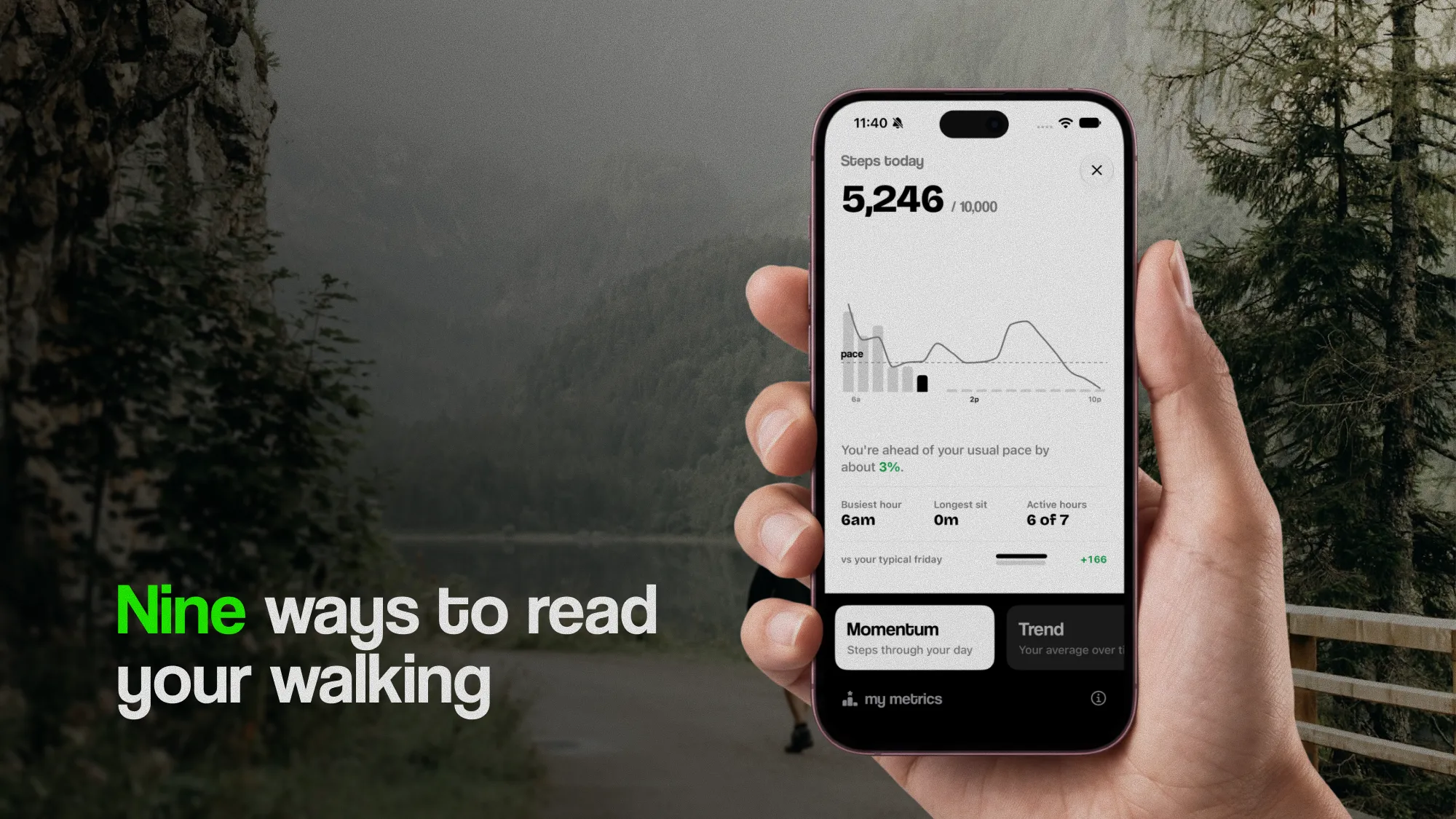

Most walking plans fail the same way. A great first week, a busy second week, and by the third the habit is gone. The total steps in that first week looked impressive. The pattern underneath it wasn't. Routine shows the pattern.
What does Routine measure?
Routine looks at the shape of your weeks rather than their size: which days you walk, how regular that is, and whether it's holding steady. A week of five ordinary walking days scores better here than one 20,000-step Saturday and six quiet days.
Why does consistency matter?
Because consistency is what turns walking from a decision into a habit, and habits are what last.
The best-known study of how habits form followed 96 people as they tried to make a new daily health behaviour, such as eating fruit with lunch or going for a 15-minute run, automatic.
- It took time. Among people whose habit settled, it took a median of 66 days to reach the point where it felt automatic, with a wide spread from a few weeks to many months.
- Simpler habits formed faster. A glass of water became automatic sooner than a demanding workout.
- Missing one day didn't matter. An occasional missed day didn't stop the habit forming. Long gaps did.
So the goal isn't a perfect streak. It's a pattern you return to.
What's a good Routine?
- Walking most days of the week, even if some days are short.
- The same time or trigger each day, such as after breakfast, at lunch or after work.
- Quick recovery after a missed day. One gap is normal. The habit is in coming back the next day.
How can you build a steadier Routine?
- Tie walking to something you already do. After the school run, after lunch, after you close your laptop.
- Make the minimum small. A ten-minute walk on a busy day keeps the pattern alive.
- Give busy days a lower target. A week that adds up beats seven identical days you can't keep.
- Use a time you protect. The Golden Hour walk planner finds the evening light where you live, if you want a reason to go.
Routine in StepUp
StepUp reads your daily steps from Apple Health and shows how regular your walking is from week to week. It needs only your iPhone. Routine is part of StepUp Pro, and it's calculated and stored on your iPhone.
It works alongside StepUp's calendar and streaks, which mark every day you hit your goal, and the walking plan, which gives busy days a lower target so the habit survives them.
The short version
- Routine shows how regular your walking is, not how much.
- Habits took a median of 66 days to become automatic in a well-known study.
- Missing one day doesn't undo a habit. Coming back the next day is what counts.
- Small, regular walks at the same time each day build the strongest routine.
Questions
How long does it take to make walking a habit?
In a well-known study of new daily habits, it took a median of 66 days for a behaviour to feel automatic, with a wide range between people. Simple, regular walks at the same time each day tend to settle faster.
Does missing a day ruin a walking habit?
No. The same study found that missing a single day didn't stop a habit forming. What matters is coming back the next day rather than letting one gap become a week.
Is it better to walk every day or a few long walks a week?
For building a habit, regular short walks usually work better than occasional long ones, because the routine itself becomes automatic. For health, the total over the week matters most.
Does Routine need an Apple Watch?
No. Routine uses the daily steps your iPhone saves to Apple Health.
Sources
Written by Dheeraj Kumar Sharma, who makes StepUp. How the guides are written.