
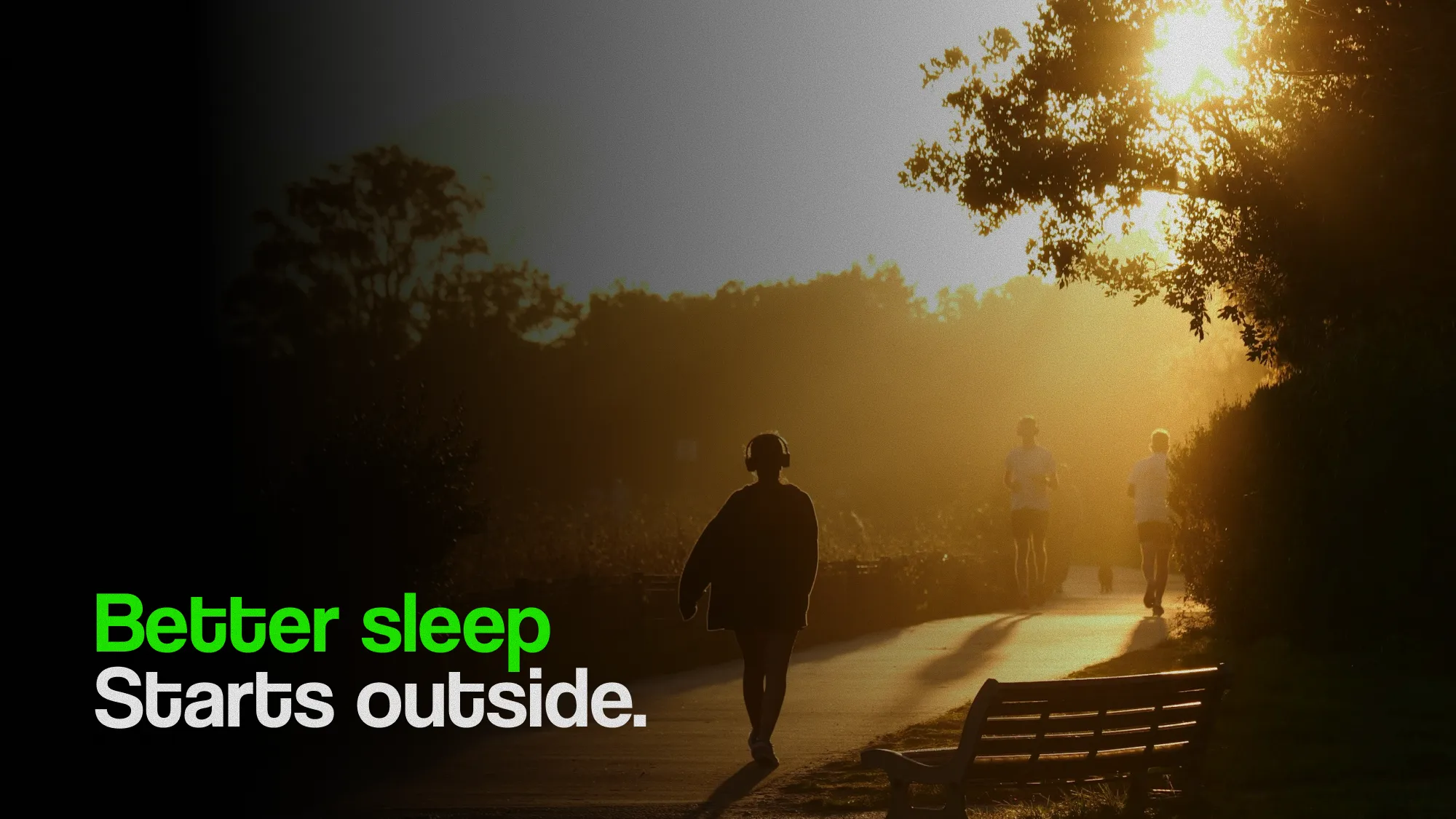
 image credit: Unsplash
One July, eight volunteers packed their tents and spent a week camping in the Rocky Mountains of Colorado. No phones, no torches, no lamps: just sunlight by day and a campfire after dark. Before they left, their body clocks ran late, like most people's do. Melatonin, the hormone that tells your body it's night, didn't start rising until around 10:30pm, a couple of hours after the sun had gone down. By the end of the week, it rose near sunset, and their whole body clock had moved about two hours earlier, with no effort at all.
Most of us can't spend a week in a tent. But the thing that reset those campers' clocks wasn't the tent. It was light: about four times more of it during the day than they usually got, and far less of it at night. A walk at golden hour, the low-sun hour after sunrise and before sunset, is the easiest way to get some of that back. This guide is about what that light does, what the walk adds, and which end of the day to pick.
Why does morning light help you sleep?
Your body runs on an internal clock, in a small part of the brain called the suprachiasmatic nucleus. Left alone, it doesn't run on exactly 24 hours. In a well-known 1999 study at Harvard, people living without time cues had clocks that averaged 24 hours and 11 minutes. A few minutes a day doesn't sound like much, but without correction, your clock drifts later every day.
Light is what corrects it. Special cells in your eyes, separate from the ones you see with, measure how bright the world is and report it to the clock. And the same light has opposite effects depending on when you get it:
- Light in the morning moves your clock earlier. You get sleepy sooner in the evening and wake more easily.
- Light late in the evening and at night moves it later, and it holds back melatonin while it's on.
So morning light does two jobs at once: it keeps your clock from drifting late, and it builds a clearer contrast between day and night. The campers had plenty of both.
How bright is golden-hour light, compared with indoors?
Much brighter than it looks. Your eyes adjust so well that indoor light feels normal, but light meters tell a different story:
| Where you are | Roughly how bright |
|---|---|
| A living room in the evening | 50–300 lux |
| A well-lit office | 300–500 lux |
| Outdoors on an overcast day | 1,000–10,000 lux |
| Outdoors in full sun | 10,000–100,000 lux |
The sun is low at golden hour, so you won't get the top of that range. But even soon after sunrise, outdoor light climbs quickly past anything you'd find indoors. A 2022 consensus of light researchers put it plainly: indoor lighting is typically at least ten times dimmer than the light outside. Their recommendation for daytime is at least 250 lux of the right kind of light at the eye. A walk outside clears that easily; a morning at a desk often doesn't.
What does the research say about morning walks and sleep?
No one has run a trial of golden-hour walks specifically. The case comes from two lines of research that point the same way: the light and the exercise.
Daylight shifts the clock. The Colorado camping study was published in 2013. A follow-up in 2017 found the same thing in winter: after a week of camping near the winter solstice, with about 13 times their usual daytime light, volunteers' melatonin rose 2.6 hours earlier. Even a weekend camping trip in summer moved it 1.4 hours earlier.
People who spend more time outside sleep better. A 2021 study of more than 400,000 adults in the UK Biobank found that each extra hour spent outdoors in daylight was linked to easier waking, less tiredness and fewer insomnia symptoms, and to being more of a morning person. That study is observational, so it can't prove the daylight did it: people who sleep well may simply get out more. But it fits what the camping studies found.
Exercise itself improves sleep. A 2015 review of 66 studies found that regular exercise has a moderate benefit for sleep quality and small benefits for how long you sleep and how quickly you fall asleep. Walking counts: you don't need hard training to see it.
Exercise also nudges the clock. In a 2019 study, people did an hour of moderate exercise at different times of day. Exercise at 7am, or between 1 and 4pm, moved their body clocks earlier. Exercise between 7 and 10pm moved them later. So a morning walk gets you two pushes in the same direction: the light, and the movement.
The honest summary: the light is the strongest part of the effect, the walk is a good way to get it, and the movement adds a smaller benefit of its own.
Is an evening golden-hour walk bad for sleep?
No. A 2019 review of 23 studies found that evening exercise didn't harm sleep in healthy adults. The one exception was vigorous exercise ending within about an hour of bedtime, which might make it harder to fall asleep. A walk at sunset is moderate, and it usually ends hours before bed.
The light at sunset doesn't work against you either. It's fading, and it's warmer and less blue than midday light, so it's a natural signal that the day is ending. What does work against you is what comes after: bright rooms and screens. A 2011 study found that ordinary room light before bed delayed melatonin's rise in almost everyone tested and shortened its night-time release by about 90 minutes. The 2022 recommendations suggest keeping light dim, at 10 lux or less at the eye, for the three hours before bed.
There's one catch. Evening exercise moves the clock later, and in summer, sunset can fall between 7 and 10pm, the window where that happens. If you already struggle to fall asleep at night, a morning walk is the better pick. If you don't, enjoy the sunset.
Morning or evening: which golden hour should you walk in?
It depends on what's wrong with your sleep, if anything:
| If you… | Walk in the… | Why |
|---|---|---|
| Struggle to fall asleep, or can't wake up | Morning | Morning light and exercise both move your clock earlier |
| Feel sleepy by 8pm and wake at 4am | Evening | Evening light pushes an early clock a little later |
| Sleep fine and want to keep it that way | Whichever you'll keep | Doing it regularly matters more than the time |
| Find winter mornings dark until 8am | As early as there's light | Any daylight beats none; midday counts too |
If you can only manage one, choose the one you can do on your busiest normal day. A walk you keep doing is worth more than a perfectly timed walk you do twice. Our guide to making walking stick covers how to tie a walk to something you already do.
How do you plan a golden-hour walk?
- Look up today's times. Golden hour shifts by a minute or two each day and changes a lot with the season and where you live. The free Golden Hour walk planner shows the morning and evening golden hours for your location.
- In the morning, go within an hour or two of waking. You don't need to catch the sunrise itself. Being outside early is what matters. Never look straight at the sun; just being in the light is enough.
- Aim for 20 to 30 minutes. There's no tested minimum for sleep, but half an hour of brisk walking on five days a week also covers the 150 minutes most guidelines ask for. See is walking enough exercise?
- Walk briskly, but not flat out. Fast enough to warm up, slow enough to talk.
- Keep the time steady. Your clock likes regularity: the same walk at about the same time each day gives it a consistent signal. StepUp's Routine metric shows how steady your walking pattern is.
- Go out even when it's cloudy. An overcast morning is still many times brighter than indoors.
- Dim things down after an evening walk. Lower the lights and put the phone down well before bed, so the darkness can do its part.
If you're starting from very little walking, build up gradually. A 30-day walking challenge is a gentle way to make a daily walk normal, and how many steps a day will help you set a target that fits you.
When is poor sleep worth seeing a doctor about?
Walks and daylight help most people sleep a little better, but they won't fix everything. If you've slept badly for months, if it's affecting your days, or if someone has noticed you snoring loudly or stopping breathing in your sleep, talk to a doctor. Long-term insomnia and sleep apnoea are common, and both have effective treatments.
How does StepUp help with golden-hour walks?
StepUp's Golden Hour feature times a walk to the sunset in your town and reminds you before it starts, so the walk happens without you having to remember to check. Your walks then feed your step count and your Routine, so you can see the habit forming week by week.
Questions
Do morning walks help you sleep better?
For most people, a little, yes. Morning daylight moves your body clock earlier, so you get sleepy sooner at night, and regular exercise has a moderate benefit for sleep quality. People who spend more daylight hours outdoors report easier waking and fewer insomnia symptoms.
How long should a morning walk be to help sleep?
There's no tested minimum. Twenty to 30 minutes outside within an hour or two of waking is a sensible target: it's plenty of daylight, and on five days a week it also covers the 150 minutes of moderate activity most guidelines ask for.
Is it bad to go for a walk before bed?
No. A 2019 review of 23 studies found evening exercise didn't harm sleep in healthy adults. Only vigorous exercise ending within about an hour of bedtime might make it harder to fall asleep, and a walk is moderate.
Does a morning walk help sleep if it's cloudy?
Yes. Outdoors on an overcast day is usually 1,000 lux or more, which is still several times brighter than a well-lit room. Your body clock responds to that difference, not to blue sky.
Do I have to walk at sunrise for it to work?
No. What matters is getting outdoor light early in your day, within an hour or two of waking. Golden hour is a handy, fixed time to anchor the habit to, but a walk a little later in the morning works too.
Sources
- Wright KP Jr et al. Entrainment of the human circadian clock to the natural light-dark cycle. Current Biology, 2013
- Stothard ER et al. Circadian entrainment to the natural light-dark cycle across seasons and the weekend. Current Biology, 2017
- Czeisler CA et al. Stability, precision, and near-24-hour period of the human circadian pacemaker. Science, 1999
- Burns AC et al. Time spent in outdoor light is associated with mood, sleep, and circadian rhythm-related outcomes: a cross-sectional and longitudinal study in over 400,000 UK Biobank participants. Journal of Affective Disorders, 2021
- Brown TM et al. Recommendations for daytime, evening, and nighttime indoor light exposure to best support physiology, sleep, and wakefulness in healthy adults. PLOS Biology, 2022
- Kredlow MA et al. The effects of physical activity on sleep: a meta-analytic review. Journal of Behavioral Medicine, 2015
- Youngstedt SD, Elliott JA, Kripke DF. Human circadian phase-response curves for exercise. Journal of Physiology, 2019
- Stutz J, Eiholzer R, Spengler CM. Effects of evening exercise on sleep in healthy participants: a systematic review and meta-analysis. Sports Medicine, 2019
- Gooley JJ et al. Exposure to room light before bedtime suppresses melatonin onset and shortens melatonin duration in humans. Journal of Clinical Endocrinology & Metabolism, 2011
- NHS: Insomnia
Written by Dheeraj Kumar Sharma, who makes StepUp. How the guides are written.