
 image credit: Unsplash
In 2011, researchers in Illinois asked a group of inactive adults to do seven abdominal exercises, two sets of ten each, five days a week for six weeks. That comes to 4,200 repetitions. At the end they could manage 47 curl-ups in a test, against 32 for the people who had done nothing. Their belly fat, their waists and their weight hadn't changed at all.
That study is why the honest answer to this question starts with a no. It gets better from there.
Can you burn fat from just your belly?
No. Your body decides where fat comes off, and working the muscle underneath doesn't change its mind.
The neatest proof comes from Chile. In 2013, eleven young adults trained one leg only: around a thousand light leg presses a session, three times a week, for twelve weeks. They lost fat, about 5% of what they carried. It came off their arms and trunk. The leg that did all the work lost no more than the leg that did none.
So walking can't aim at your belly, and neither can anything else. It doesn't need to. Walking burns fat from everywhere, and the belly is one of the places that answers.
What are the two kinds of belly fat?
| Under the skin | Around the organs | |
|---|---|---|
| Its name | Subcutaneous fat | Visceral fat |
| Where it sits | Just under the skin: the part you can pinch | Deep in the abdomen, around the liver and gut |
| Can you see it? | Yes | No. Only a scan can measure it |
| Why it matters | Mostly how your clothes fit | The stronger predictor of illness and early death |
| Does walking shrink it? | Yes | Yes, sometimes before your weight changes |
The second kind is the one doctors worry about, and it's the one walking is good at.
What do the walking studies show?
Seattle, 2003. 173 women aged 50 to 75, all overweight and inactive, were split into two groups for a year. One stretched. The other did moderate exercise, mostly walking, and averaged just under three hours a week. After twelve months the walkers weighed 1.4 kg less than the stretchers and carried less fat under the skin of the belly. Their deep belly fat fell too, though that result fell just short of what the trial could call certain. The more minutes a woman walked, the more fat she lost.
South Korea, 2014. Twenty women with obesity either carried on as normal or walked for 50 to 70 minutes, three days a week. After twelve weeks both kinds of belly fat had fallen in the walkers and neither had moved in the others. It's a small trial, but it tested walking and nothing else.
Canada, 2000. 52 men with obesity spent three months in one of four groups. One group exercised every day and ate enough extra to keep their weight exactly where it was. The scale didn't move, and their belly fat and visceral fat both fell.
117 studies together, 2016. A Dutch team pooled trials covering 4,815 people. When people exercised without losing any weight, their visceral fat still fell by 6.1%. When people dieted without losing weight, it barely changed.
How much walking does it take?
A Japanese review of sixteen trials put a number on it: visceral fat started to fall at about 10 MET-hours of aerobic exercise a week. One MET is the energy you use sitting still, so an hour of something worth 4 METs earns 4 MET-hours.
Here's what that means on foot:
| Your week | Pace | MET-hours | Enough? |
|---|---|---|---|
| 5 walks of 30 minutes | Easy, 2.5 mph | 7.5 | Not quite |
| 5 walks of 30 minutes | Brisk, 3.5 mph | 10.8 | Yes, just |
| 5 walks of 45 minutes | Brisk, 3.5 mph | 16.1 | Yes |
| An hour every day | Brisk, 3.5 mph | 30.1 | Well past it |
Two things stand out. The first row and the second are the same half hour, and only the brisk one gets there. And the amount that works is the familiar 150 minutes a week, which what walking 30 minutes a day does covers in full.
Brisk means about 100 steps a minute or more: you can talk, but you couldn't sing. What is the average walking speed? has the numbers by age, and the walking pace calculator works out yours.
A trial in North Carolina shows what's at stake at the low end. 175 inactive, overweight adults were followed for six to eight months. The ones who did no exercise gained 8.6% more visceral fat in half a year. The ones who did the equivalent of walking about 11 miles a week held steady. It took more than that, and harder, to make visceral fat shrink, by about 7%.
So a modest walking habit holds the line, and a bigger one moves it back.
Does walking faster work better?
It looks that way. In a 2008 trial in Virginia, 27 women with obesity were followed for sixteen weeks. One group exercised five days a week and kept every session easy. Another made three of the five hard. Both burned the same 400 calories each time. Only the group with the hard sessions lost a measurable amount of belly fat, of both kinds.
It's one small study, so don't read it as "easy walks are useless": the Seattle and Korean trials used moderate walking and it worked. Read it as a reason to make some of your walks harder. Pick a route with a hill, or try Japanese interval walking, which swaps three fast minutes with three slow ones.
What about weights? A review of 35 trials found that aerobic exercise reduced visceral fat and that strength training on its own didn't. Strength work is still worth doing for your muscles and bones, and is walking enough exercise? has a short routine. It just isn't the part that shrinks your waist.
Why is the scale the wrong thing to watch?
Because belly fat can fall while your weight doesn't. That's what happened to the Canadian men, and across the 117 pooled studies. If you only weigh yourself, a walking habit that's working can look like one that isn't.
A tape measure is better. The US National Heart, Lung, and Blood Institute's method takes ten seconds:
- Stand up and put the tape around your middle, just above your hip bones.
- Breathe out, and read the tape straight after.
The institute says the risk to your health rises with a waist over 35 inches for women or over 40 inches for men. Measure every two weeks, at the same time of day, and write it down. If you're over those lines, or your waist is growing and you can't say why, it's worth talking to your doctor.
What can't walking do?
- Cancel out what you eat. A brisk 30-minute walk burns about 150 calories for someone who weighs 70 kg (154 lb). A snack puts that back. The steps to calories calculator shows your own figure. Walking changes where your fat sits and how fit you are, and food decides most of your weight.
- Work fast. The shortest trial here ran twelve weeks and the longest a year. Nothing shrinks a waist in ten days.
- Choose the spot. If your body gives up fat from your face and arms first, that's where it will go first.
What does a week that works look like?
- Walk briskly for 30 minutes, five days a week. That's the 10.8 MET-hours in the table. Three ten-minute walks add up the same as one of thirty.
- Make two of them harder. Add a hill, or five rounds of fast and slow.
- Build up to it. If 150 brisk minutes is a long way from where you are, raise your steps by no more than 10% a week, or follow a walking plan for beginners.
- Measure your waist every two weeks, and give it three months before you judge.
The hard part is the three months. StepUp's walking plan sets each week's target from what you've really been walking, so it's one you can hit, and Tempo shows your cadence on every walk, so you can see whether brisk was brisk.
The short version
- No exercise takes fat from one place. Six weeks of abdominal exercises changed nothing about belly fat.
- Walking does reduce belly fat, including the deep kind around your organs.
- It takes about 150 brisk minutes a week. Easy strolling for the same time falls short.
- Less than that still helps: it stops visceral fat building up.
- Watch your waist, not your weight. Fat can fall while the scale stands still.
Questions
How long does it take to lose belly fat by walking?
Expect about three months before a tape measure shows it. The trials that found less belly fat ran from twelve weeks to a year, with people walking briskly for roughly 150 minutes a week or more. Nothing in the research supports a change in days.
How many steps a day does it take to lose belly fat?
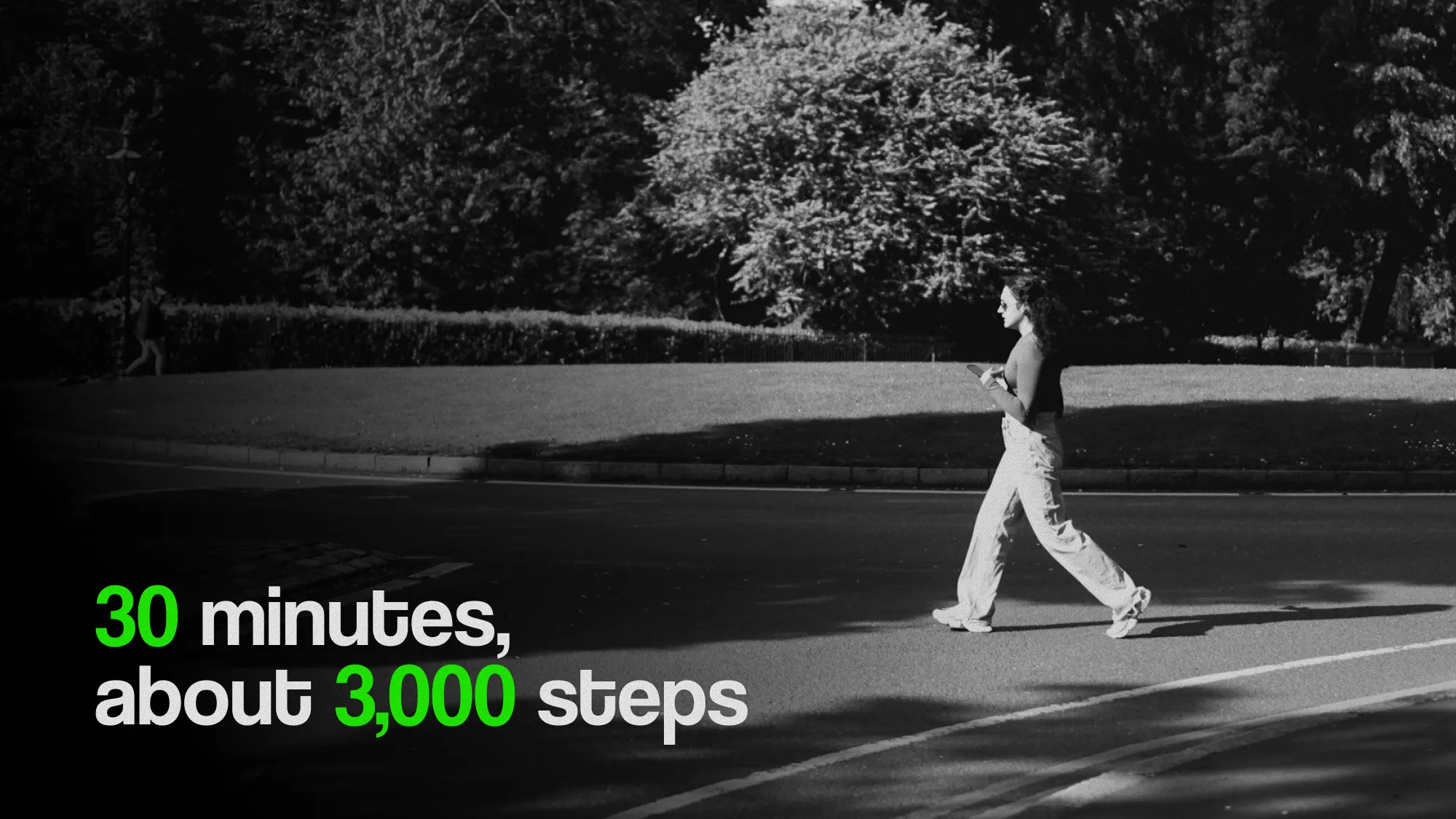
No trial has set a step count for it. The studies counted minutes: about 150 brisk minutes a week, or 30 minutes on five days. At a brisk 100 steps a minute, that's around 3,000 brisk steps on each of those days, on top of your everyday steps.
Do sit-ups or crunches burn belly fat?
No. In a 2011 trial, six weeks of abdominal exercises five days a week made people better at curl-ups but didn't change their belly fat, waist or weight. Exercise can't take fat from one chosen place.
Can you lose belly fat by walking without dieting?
Yes, to a degree. In trials where people exercised without losing weight, their visceral fat still fell by about 6% on average. For a bigger change in your weight or waist, what you eat matters more than how far you walk.
Is walking or running better for belly fat?
Harder exercise seems to shift more belly fat for the same calories, and running burns more per minute. But walking briskly for 150 minutes a week has reduced belly fat in trials, and the exercise you keep doing for months is the one that works.
Sources
- Vispute et al. (2011), The effect of abdominal exercise on abdominal fat, Journal of Strength and Conditioning Research
- Ramírez-Campillo et al. (2013), Regional fat changes induced by localized muscle endurance resistance training, Journal of Strength and Conditioning Research
- Irwin et al. (2003), Effect of exercise on total and intra-abdominal body fat in postmenopausal women: a randomized controlled trial, JAMA
- Hong et al. (2014), Effect of walking exercise on abdominal fat, insulin resistance and serum cytokines in obese women, Journal of Exercise Nutrition & Biochemistry
- Ross et al. (2000), Reduction in obesity and related comorbid conditions after diet-induced weight loss or exercise-induced weight loss in men, Annals of Internal Medicine
- Verheggen et al. (2016), A systematic review and meta-analysis on the effects of exercise training versus hypocaloric diet: distinct effects on body weight and visceral adipose tissue, Obesity Reviews
- Ohkawara et al. (2007), A dose-response relation between aerobic exercise and visceral fat reduction: systematic review of clinical trials, International Journal of Obesity
- Slentz et al. (2005), Inactivity, exercise, and visceral fat. STRRIDE: a randomized, controlled study of exercise intensity and amount, Journal of Applied Physiology
- Irving et al. (2008), Effect of exercise training intensity on abdominal visceral fat and body composition, Medicine & Science in Sports & Exercise
- Ismail et al. (2012), A systematic review and meta-analysis of the effect of aerobic vs. resistance exercise training on visceral fat, Obesity Reviews
- Ainsworth et al. (2011), 2011 Compendium of Physical Activities: a second update of codes and MET values, Medicine & Science in Sports & Exercise
- Tudor-Locke et al. (2019), Walking cadence (steps/min) and intensity in 21–40 year olds: CADENCE-adults, Int J Behav Nutr Phys Act
- National Heart, Lung, and Blood Institute: Assessing your weight and health risk
Written by Dheeraj Kumar Sharma, who makes StepUp. How the guides are written.