
 image credit: Unsplash
Thirty minutes a day is the most common walking advice there is, and it's good advice. It's short enough to fit around work, and it's enough walking to meet the main exercise guideline. In the long-term studies, it's also where some of the biggest gains in health come from. Here's what half an hour of walking adds up to, what it does for you, and when it's worth doing more.
What does a 30-minute walk add up to?
How much ground you cover depends on your pace and your stride, but for most adults a 30-minute walk works out roughly like this:
| Easy stroll | Brisk walk | Fast walk | |
|---|---|---|---|
| Pace | 2.5 mph (4 km/h) | 3–3.5 mph (5–5.5 km/h) | 4 mph (6.5 km/h) |
| Steps a minute | 85–95 | 100–115 | 120–130 |
| Steps in 30 minutes | about 2,700 | 3,000–3,500 | 3,600–3,900 |
| Distance | 1.25 miles (2 km) | 1.5–1.75 miles (2.5–2.8 km) | 2 miles (3.2 km) |
| Calories, at 70 kg (154 lb) | about 105 | 120–135 | about 150 |
| Counts as exercise? | Movement, not exercise | Yes, moderate | Yes, moderate |
Taller people take longer strides, so they cover more distance in fewer steps, and heavier people burn more calories at the same pace. The steps to miles calculator works out the distance for your height, the steps to calories calculator does the same for your weight, and the walking pace calculator shows where your own walks sit.
Does 30 minutes a day meet the exercise guidelines?
Yes, if the walk is brisk. The World Health Organization and the US Physical Activity Guidelines both ask adults for 150 to 300 minutes of moderate aerobic activity a week. Thirty minutes on five days is 150. Thirty minutes every day is 210, well inside the range.
The catch is the word moderate. A slow amble is good for you, but it doesn't count toward those minutes. A walk is moderate exercise when:
- You can talk but not sing. Full sentences are fine; a song isn't.
- You're taking about 100 steps a minute or more. Count your steps for 15 seconds: 25 or more is brisk. StepUp's Tempo metric shows your cadence for every walk.
- You're going about 2.5 mph (4 km/h) or faster, which is the CDC's rough line for brisk walking.
The 30 minutes don't have to come in one go. The 2018 US guidelines dropped the old rule that only bouts of 10 minutes or more counted, so three brisk 10-minute walks add up the same as one 30-minute walk.
What 30 minutes of walking doesn't cover is muscle strength: the guidelines also ask for strength work on two days a week. Is walking enough exercise? explains that gap and what to add.
What does walking 30 minutes a day do for your health?
Most of what we know comes from large studies that followed hundreds of thousands of people for years. They're observational, so they show what goes with walking rather than proving it causes every benefit, but the pattern is consistent across countries, ages and research teams.
You're likely to live longer. A 2023 review of 94 studies covering more than 30 million people found that 150 minutes a week of moderate activity, about 22 minutes a day, was linked to a 31% lower risk of early death than doing none. Even half that, about 11 minutes a day, was linked to a 23% lower risk. A 2011 study of over 400,000 adults in Taiwan found that just 15 minutes a day was linked to a 14% lower death rate and about three extra years of life, with each further 15 minutes lowering the risk by another 4%.
Your heart and circulation benefit. A 2008 review of 18 studies and nearly 460,000 people found that those who walked the most had about a 31% lower risk of heart disease and stroke, and a 32% lower risk of dying during the studies, than those who walked the least. Walking pace mattered even more than the amount, which is one more reason to make the walk brisk. In randomised trials, weeks to months of regular walking lowered blood pressure, body fat and body mass index, and raised aerobic fitness, in people who had been inactive.
Your blood sugar stays steadier. In a 2016 trial, 41 adults with type 2 diabetes walked 150 minutes a week in two ways: 30 minutes at any time of day, or 10 minutes after each meal. With the after-meal walks, blood sugar after eating was 12% lower on average, and 22% lower after the evening meal, the biggest and most carbohydrate-heavy meal of the day.
Your mood benefits. A 2022 review of 15 studies and over 190,000 people found that adults doing the equivalent of 2.5 hours of brisk walking a week, 30 minutes on five days, had a 25% lower risk of depression than those doing no activity. At half that amount, the risk was still 18% lower. Most of the benefit came from going from nothing to something.
It helps a little with weight. A brisk 30-minute walk burns about 120 to 135 calories for someone weighing 70 kg (154 lb), so a walk every day is roughly 900 calories a week. That's worth having, and it helps keep weight off, but walking on its own rarely makes a big difference to weight. What you eat matters at least as much.
How soon will you notice a difference?
Some changes start with the first walk, and some take months:
- The same day. A walk after a meal blunts the rise in blood sugar that follows it, and many people feel more awake and less tense for a while afterwards.
- The first few weeks. The same route at the same pace starts to feel easier, as your heart and legs adapt. StepUp's Fitness metric tracks your walking speed against your heart rate, so you can see it rise.
- After a few months. This is the timescale of the trials that found lower blood pressure, less body fat and better aerobic fitness.
- Over years. The lower risks of heart disease, depression and early death in the long-term studies belong to people who kept walking. The walk you keep doing matters more than any one walk.
Is it better to walk 30 minutes at once or split it up?
For the guidelines, it makes no difference: every brisk minute counts. For your health, both work, and each has an edge:
- One 30-minute walk is easier to make a habit, and it gives you time to settle into a properly brisk pace. In the 2022 step studies covered in Is 10,000 steps a day a myth?, people whose best 30 minutes of the day were brisk did better, even at the same step count.
- Three 10-minute walks after meals do more for blood sugar, as the diabetes trial above found, and they're easier to fit into a busy day.
Pick the one you'll actually keep doing. Making walking stick has more on building a walk into your routine so it lasts.
Is 30 minutes a day enough, or should you walk more?
For most people, 30 minutes of brisk walking a day is enough to get most of the benefit. More still helps, but each extra minute adds a little less: the guidelines see extra benefit up to 300 minutes a week, about 45 minutes a day, and the 2023 review found the gains flattened beyond the recommended amount.
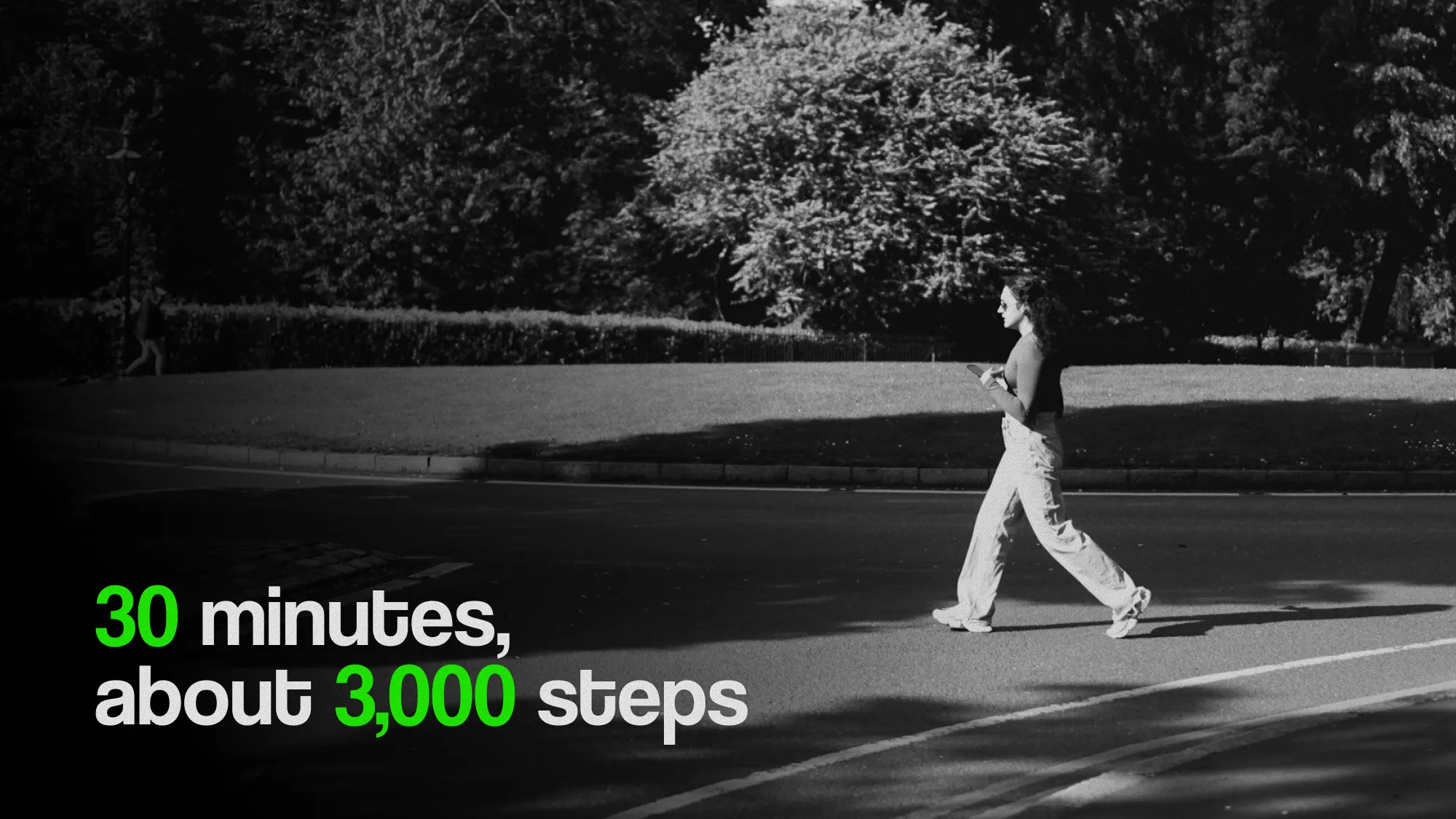
It also helps to think in steps. A 30-minute walk is about 3,000 to 3,500 steps. If your normal day is already 4,000 or 5,000 steps, the walk takes you to 7,000 or 8,000, which is around where the research on daily steps finds the benefits start to level off. How many steps should I walk a day? turns that research into a target for your age.
If you already walk 30 minutes a day and want more from it, make it harder before you make it longer: add a hill, a few fast minutes, or try Japanese interval walking, which alternates three minutes fast with three minutes easy.
What if 30 minutes is too much to start with?
Start with what you can do, even if that's 10 minutes. Any brisk walking is better than none, and the biggest gains in every study above come from going from very little to some. Add five minutes a week and you'll reach 30 in about a month without a week that feels like a shock.
A walking plan for beginners lays out those first weeks, and the step goal calculator sets a daily target you'll actually hit. If you have a heart condition, diabetes or joint problems, or haven't been active for a long time, check with your doctor before you start.
The short version
- A brisk 30-minute walk is about 3,000 to 3,500 steps, 1.5 to 1.75 miles (2.5 to 2.8 km), and 120 to 135 calories for someone weighing 70 kg.
- Done on five days a week or more, it meets the WHO and US minimum of 150 minutes of moderate activity.
- Research links that much activity to around a 30% lower risk of early death and heart disease, steadier blood sugar and a 25% lower risk of depression.
- It needs to be brisk: about 100 steps a minute, at a pace where you can talk but not sing.
- One walk or three short ones both count. Add strength work twice a week to cover the rest of the guidelines.
Questions
How many steps is a 30-minute walk?
About 3,000 to 3,500 at a brisk pace of 100 to 115 steps a minute. An easy stroll is closer to 2,700, and a fast walk can reach nearly 4,000. Taller people take fewer, longer steps.
How far do you walk in 30 minutes?
About 1.5 to 1.75 miles (2.5 to 2.8 km) at a brisk 3 to 3.5 mph. An easy stroll covers about 1.25 miles (2 km), and a fast walk about 2 miles (3.2 km).
How many calories does walking 30 minutes burn?
About 120 to 135 calories at a brisk pace for someone weighing 70 kg (154 lb). Heavier people burn more, and walking uphill burns far more. The steps to calories calculator estimates yours.
Can walking 30 minutes a day help you lose weight?
It helps, but slowly. A daily brisk walk burns roughly 900 calories a week, which is useful for keeping weight off. On its own it rarely makes a big difference to weight: what you eat matters at least as much.
Is it OK to walk 30 minutes every day?
Yes. Walking is low-impact, and most people don't need rest days from it. Thirty minutes every day is 210 minutes a week, inside the WHO and US range of 150 to 300 minutes of moderate activity.
Sources
- World Health Organization (2020), WHO guidelines on physical activity and sedentary behaviour
- US Department of Health and Human Services, Physical Activity Guidelines for Americans, 2nd edition
- CDC: How to measure physical activity intensity
- Tudor-Locke et al. (2019), Walking cadence (steps/min) and intensity in 21–40 year olds: CADENCE-adults, Int J Behav Nutr Phys Act
- Garcia et al. (2023), Non-occupational physical activity and risk of cardiovascular disease, cancer and mortality outcomes: a dose–response meta-analysis of large prospective studies, British Journal of Sports Medicine
- Wen et al. (2011), Minimum amount of physical activity for reduced mortality and extended life expectancy: a prospective cohort study, The Lancet
- Hamer and Chida (2008), Walking and primary prevention: a meta-analysis of prospective cohort studies, British Journal of Sports Medicine
- Murtagh et al. (2015), The effect of walking on risk factors for cardiovascular disease: an updated systematic review and meta-analysis of randomised control trials, Preventive Medicine
- Reynolds et al. (2016), Advice to walk after meals is more effective for lowering postprandial glycaemia in type 2 diabetes mellitus than advice that does not specify timing, Diabetologia
- Pearce et al. (2022), Association between physical activity and risk of depression: a systematic review and meta-analysis, JAMA Psychiatry
Written by Dheeraj Kumar Sharma, who makes StepUp. How the guides are written.