
 image credit: Unsplash
Most walking plans start with a number someone else picked: 10,000 steps, or an hour a day. For a beginner, that's the fastest way to quit. A plan that works starts from what you walk now, asks for a little more each week, and only speeds up once the distance feels easy.
This guide sets out an eight-week plan built that way, how to find your starting point, and what to do when a week goes badly.
What makes a good beginner walking plan?
Three things, and none of them is a big number.
- It starts from you. Your first target is a little more than your current average, not a goal from a poster.
- It rises slowly. About 10% a week is small enough that no week is a shock, and large enough to add up: in six weeks it takes 4,000 steps a day to 7,000.
- It gets you walking before it gets you walking fast. Total steps matter more than speed. Brisk walking comes once the distance is easy.
The research backs that order. Large studies of step counts find that the risk of early death falls fastest over the first few thousand extra steps a day, then levels off around 6,000–8,000 at 60 and over and 8,000–10,000 under 60. A beginner gets the most out of the first weeks of a plan, so a plan you finish beats one you abandon. How many steps should I walk a day? covers those studies in detail.
Before you start
Find your average. In the Health app on your iPhone, open Steps and look at the daily average over the last two to four weeks. A single day is too noisy: a trip to the shops can double it. That average is week zero of your plan.
Check with your doctor if you need to. Walking is about as gentle as exercise gets, but if you have a heart, lung or joint condition, are pregnant, or haven't been active for a long time, ask what's a sensible place to start.
Wear comfortable shoes. You don't need anything special. Trainers or flat shoes with some cushioning and good support are enough, in a size that leaves room for your toes.
The eight-week walking plan
The plan below starts from 4,000 steps a day, close to what many beginners walk. If your average is different, start from yours and raise it by the same 10% each week. The step goal calculator works out the weeks for any starting number.
| Week | Daily target | Extra steps | Roughly |
|---|---|---|---|
| 1 | 4,400 | +400 | a 4-minute walk |
| 2 | 4,800 | +800 | an 8-minute walk |
| 3 | 5,300 | +1,300 | a 13-minute walk |
| 4 | 5,800 | +1,800 | an 18-minute walk |
| 5 | 6,400 | +2,400 | a 24-minute walk |
| 6 | 7,000 | +3,000 | a 30-minute walk |
| 7 | 7,000 | hold | make two walks a week brisk |
| 8 | 7,000 or more | hold, or +10% | make most walks brisk |
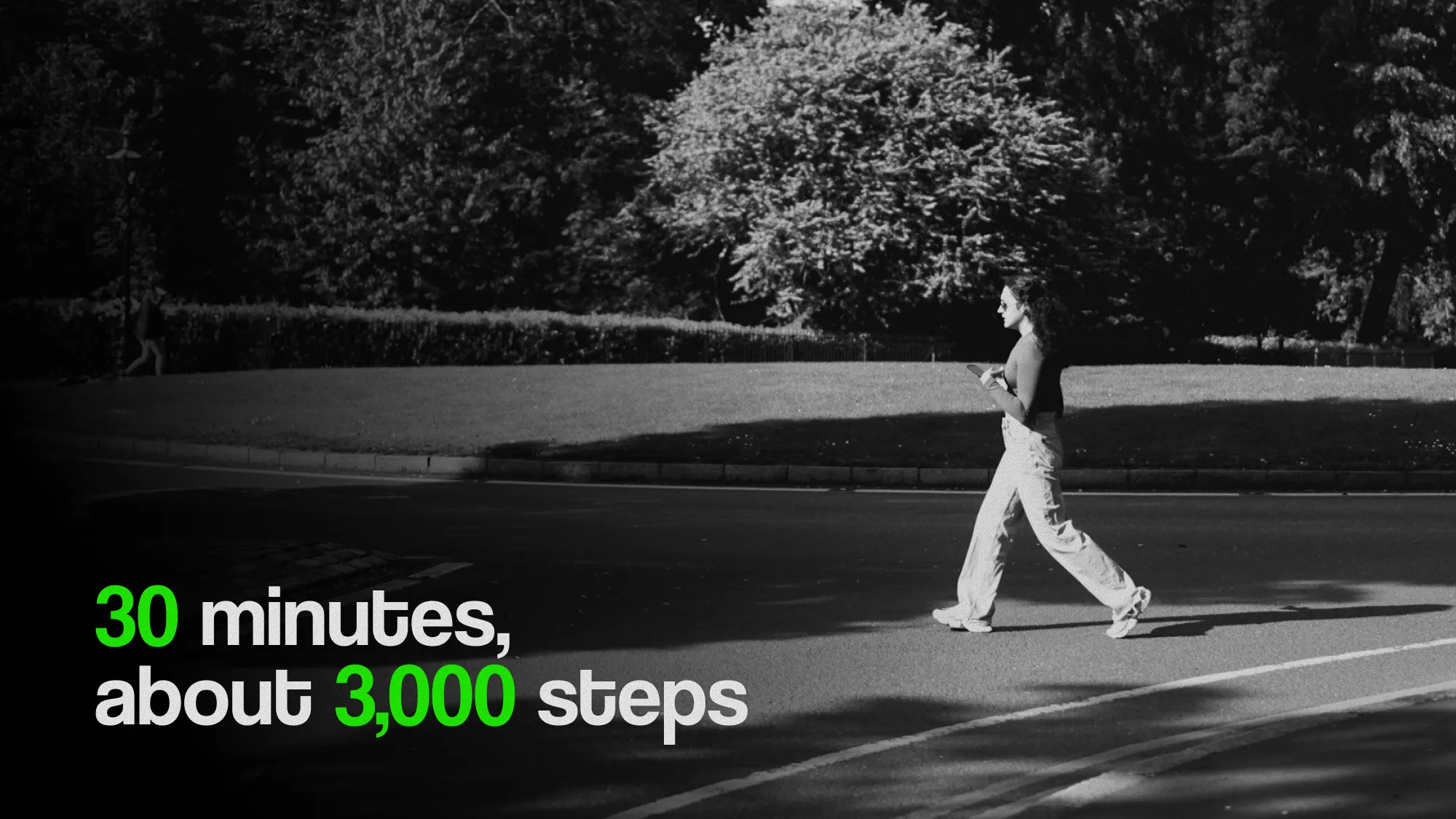
The minutes assume about 100 steps a minute, an ordinary walking pace. They're the time it takes to add those steps in one go, but the extra can come from anywhere: two short walks, a longer way to the station, a walk after dinner.
By week six, the extra 3,000 steps are about a 30-minute walk. Five of those a week make 150 minutes, the minimum the WHO and the US guidelines recommend for adults. Weeks seven and eight keep the distance where it is and change the pace instead.
Weeks 1 and 2: build the habit
The targets here are deliberately small. Four hundred extra steps is a walk around the block. The point of the first two weeks isn't fitness, it's showing up: walking at roughly the same time each day until it stops needing a decision.
Pick a slot you already have. After breakfast, at lunch, after dinner, or as soon as you get home. Ten minutes after a meal is easy to remember and easy to keep.
Weeks 3 to 6: add distance
Now the extra steps start to become a real walk: about 13 minutes in week three, and 30 by week six. Keep the pace easy, somewhere you could hold a full conversation.
If you'd rather not do it all at once, split it. Two 15-minute walks count the same as one 30-minute walk: the large studies counted every step of the day, not just steps on deliberate walks.
Weeks 7 and 8: pick up the pace
Once 7,000 steps feels comfortable, speed some of them up. A brisk walk is one where you can still talk but couldn't sing the words to a song. The NHS puts it at about 3 miles an hour, and a lab study of adults put the threshold for moderate exercise at around 100 steps a minute. To check yours, count your steps for 15 seconds and multiply by four.
Start with a few minutes of brisk walking in the middle of your usual walk, then build up. The walking pace calculator turns a walk's distance and time into a pace.
What if you miss a day or a week?
Carry on from where you are. A missed day doesn't need making up, and two extra walks tomorrow is how sore shins start.
If a whole week felt like a struggle, repeat it rather than moving up. The 10% is a ceiling, not a deadline. Holding a target for a second week is still progress, because it's a week of walking you'd otherwise have dropped.
How to keep going after week eight
You have three choices, and all of them are good:
- Keep raising your target about 10% a week until you reach around 8,000–10,000 steps under 60, or 6,000–8,000 at 60 and over.
- Hold your steps and walk faster, making most of your walks brisk.
- Hold where you are. At 7,000 steps a day, you already have most of the benefit seen in the research. Is 10,000 steps a day a myth? explains why.
The WHO also recommends muscle-strengthening activity on two or more days a week. Walking uphill and climbing stairs help, but some bodyweight exercises, like squats or getting up from a chair without your hands, round out a walking plan.
Ways to make walking easier to keep
- Walk at the same time each day. The Golden Hour walk planner finds the softest morning and evening light where you live, if you want a reason to go.
- Make trips longer. Get off a stop early, park at the far end, take the stairs.
- Walk while you talk. Calls and one-to-one meetings work on foot.
- Picture the distance. The steps to miles calculator turns a target into miles or kilometres for your height.
- Give busy days a smaller target. A week that adds up matters more than seven identical days.
How StepUp builds your plan
StepUp's walking plan works the same way as this guide. It reads your step history from Apple Health, starts from what you actually walk, and raises your target each week by no more than 10%. Each day of the week gets its own target, so a busy Tuesday doesn't ask as much as a free Sunday, and each week ends with a recap of how it went.
All of it happens on your iPhone: your steps never leave it.
The short version
- Start from your own average, not from 10,000.
- Add about 10% a week: from 4,000 steps, that's 7,000 by week six.
- Keep the pace easy until the distance is easy, then make some walks brisk.
- Five 30-minute walks a week meet the WHO's minimum for adults.
- Missed a day? Carry on. Hard week? Repeat it.
Questions
How long should a beginner walk each day?
Start with 5 to 10 minutes on top of what you already walk, and add a few minutes each week. Most beginners can reach a 30-minute walk in about six weeks. Five of those a week meet the WHO’s minimum of 150 minutes of moderate activity.
Is walking 30 minutes a day enough exercise?
For most adults, yes, as a base. Thirty brisk minutes on five days a week meets the WHO’s minimum of 150 minutes of moderate activity. The WHO also recommends muscle-strengthening activity on two or more days a week.
How fast should a beginner walk?
At an easy pace to begin with, where you could hold a full conversation. Once your step target feels comfortable, make some walks brisk: you can still talk, but couldn’t sing. That’s around 100 steps a minute, or about 3 miles an hour.
Should beginners walk every day?
It helps, but it isn’t required. Walking at the same time most days makes the habit easier to keep, and a gentle walk is fine on consecutive days. If you’re sore or tired, take a day off or walk less.
What if I miss a week of my walking plan?
Pick up at the last week that felt comfortable, not where the plan says you should be. The 10% weekly rise is a ceiling, not a deadline, and repeating a week is still progress.
Sources
- World Health Organization, Physical activity fact sheet
- US Department of Health and Human Services (2018), Physical Activity Guidelines for Americans, 2nd edition
- NHS, Walking for health
- Tudor-Locke et al. (2019), Walking cadence (steps/min) and intensity in 21–40 year olds: CADENCE-adults, International Journal of Behavioral Nutrition and Physical Activity
- Paluch et al. (2022), Daily steps and all-cause mortality: a meta-analysis of 15 international cohorts, The Lancet Public Health
- Ding et al. (2025), Daily steps and health outcomes in adults: a systematic review and dose-response meta-analysis, The Lancet Public Health
Written by Dheeraj Kumar Sharma, who makes StepUp. How the guides are written.