
 image credit: Unsplash
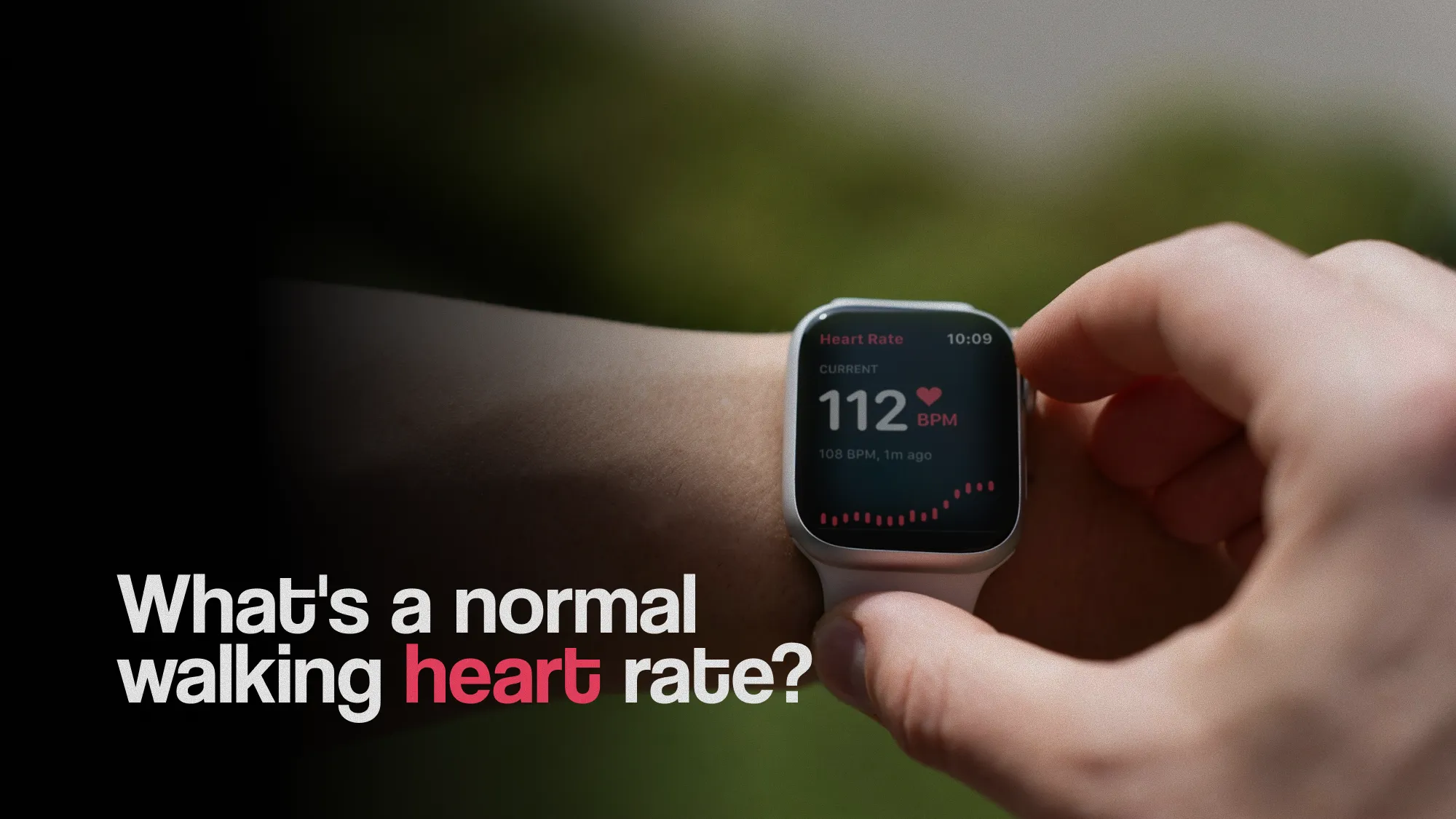
Your heart rate on a walk isn't one number. It moves with how fast you go, the hills, the weather and how you slept, and above all with your age and fitness. That's why "what's normal?" has a range for an answer, and why your own pattern over weeks tells you more than any single reading.
What is a normal heart rate while walking?
For a healthy adult, an easy, everyday walk usually lifts heart rate to about 57–63% of its maximum, and a brisk walk to 64–76%. The American College of Sports Medicine calls these the light and moderate zones; moderate is the intensity exercise guidelines count. Your maximum falls with age, so the same walk gives a lower number as you get older.
| Age | Maximum heart rate | Easy walk (57–63%) | Brisk walk (64–76%) |
|---|---|---|---|
| 20 | 194 | 111–122 | 124–147 |
| 30 | 187 | 107–118 | 120–142 |
| 40 | 180 | 103–113 | 115–137 |
| 50 | 173 | 99–109 | 111–131 |
| 60 | 166 | 95–105 | 106–126 |
| 70 | 159 | 91–100 | 102–121 |
| 80 | 152 | 87–96 | 97–116 |
Beats a minute. Maximum heart rate here is 208 minus 0.7 × your age.
That maximum comes from a 2001 analysis of 351 studies, which found that 208 minus 0.7 times your age fits better than the familiar 220 minus your age, especially for older adults. Both are averages: your own maximum can sit 10 beats or more either side, which shifts every number in the table. The walking heart rate calculator works out the zones for your exact age.
A slow stroll can sit below the easy zone altogether. That's normal too: it still counts as moving, just not as exercise.
How does walking heart rate compare with resting heart rate?
A normal resting heart rate for adults is 60 to 100 beats a minute, according to the American Heart Association, and very fit people can sit closer to 40. Walking adds to that. How much depends on how hard the walk is for you, not just how fast it is: a pace that barely lifts a regular walker's heart rate can push a beginner's into the brisk zone.
What does Apple Watch's walking heart rate average mean?
If you wear an Apple Watch, the Health app shows a Walking Heart Rate Average: your average heart rate during ordinary walking through the day, which the watch works out from background heart rate readings and its motion sensors. You'll find it in Health under Browse, then Heart. It leaves out workouts, so it reflects everyday walking: to the shops, around the office, up the stairs.
Apple doesn't publish a normal range for it, and it isn't a target. It's most useful as a trend. A walking average that drifts down over months, for the same kind of walking, usually means your heart is getting fitter. One that climbs for weeks with no obvious reason, such as a heatwave or a cold, is worth noticing. Your iPhone can't measure heart rate on its own; step tracking without an Apple Watch covers what it does record.
What makes your heart rate higher on a walk?
Heart rate rises with more than speed. On the same route, it can read noticeably higher because of:
- Hills and stairs. Climbing is much harder work than the flat: the treadmill calories tool shows how much each 1% of incline adds.
- Heat and humidity. Your heart pumps extra blood to the skin to cool you, so a summer walk reads higher than the same walk in autumn.
- Not drinking enough. Less fluid means less blood, so the heart beats faster to move it.
- Caffeine, stress and poor sleep. All three can lift heart rate before you've taken a step.
- Coming down with something. A raised heart rate is often one of the first signs of a cold or a fever.
- Carrying weight. A heavy bag, a backpack or a child on your shoulders all add to the work.
- Altitude. Thinner air means less oxygen in each breath.
On long walks in the heat, heart rate can also creep up over an hour even at a steady pace. It's called cardiac drift, it's normal, and it's a reason to slow down and drink on hot days.
Why might your heart rate stay low on a walk?
The most common reason is fitness. A trained heart pumps more blood with each beat, so it needs fewer beats for the same walk. If an easy walk barely lifts yours, walk faster or find a hill to reach the brisk zone.
Medicines matter too. Beta blockers, and some other heart and blood pressure medicines, hold heart rate down, so age-based zones like the ones above will be too high. If you take them, the talk test below is a better guide, and your doctor can tell you what to aim for.
How can you tell a walk is brisk without a heart rate monitor?
- The talk test. At a moderate pace you can talk, but not sing. If you can only say a few words before pausing for breath, it's vigorous.
- Your cadence. About 100 steps a minute is where walking becomes moderate exercise for most adults. Count your steps for 15 seconds: 25 or more is brisk. StepUp's Tempo metric shows your cadence for you.
- Your pulse. Stop, find the pulse at your wrist, count the beats for 10 seconds and multiply by six. Do it straight away: heart rate starts falling as soon as you stop.
Does walking heart rate go down as you get fitter?
Yes. Over weeks of regular walking, the same pace takes fewer beats, or the same heart rate carries you faster. It's one of the clearest signs that walking is working, and it's what StepUp's Fitness metric tracks: your walking speed against your heart rate. Effort shows the other side, how hard each walk was for your heart. Both need an Apple Watch; walking metrics, explained covers all nine.
If you're just starting out, a walking plan for beginners builds up at a pace your heart and legs can keep up with.
When is walking heart rate a reason to see a doctor?
A high number on a hill, in the heat or on a fast walk is normal if you feel well. What matters is how you feel, and whether the pattern changes.
Stop and call 911 in the US, or 999 in the UK, if you have chest pain or pressure, pain spreading to your arm, jaw or back, or you feel faint or badly short of breath.
Book a check with your doctor if:
- your heart races, flutters or feels irregular on easy walks;
- you get far more out of breath than the walk explains, or dizzy;
- your heart rate stays high long after you stop;
- walks that used to be easy have felt much harder for weeks;
- your resting heart rate is regularly over 100, or under 60 and you feel tired or dizzy.
Don't expect an Apple Watch to warn you mid-walk: its high heart rate notification only goes off when your heart rate stays high while you seem to have been inactive for 10 minutes.
The short version
- An easy walk usually puts heart rate at 57–63% of its maximum, and a brisk walk at 64–76%.
- Your maximum is roughly 208 minus 0.7 × your age: about 180 at 40, and 166 at 60.
- Hills, heat, dehydration, caffeine, poor sleep and illness push it up. Fitness and some medicines hold it down.
- Apple Watch's walking heart rate average is best read as a trend: falling over months means you're getting fitter.
- How you feel matters more than the number. Chest pain or faintness on a walk needs help straight away.
Questions
Is 120 bpm a normal heart rate for walking?
Usually, yes. For most adults between about 30 and 70 it’s a brisk walk, in the moderate zone exercise guidelines count. At 20 it’s an easy walk, and over 75 it’s close to vigorous, which is fine if you feel well.
Is 140 bpm too high when walking?
Not if you feel well. It’s a brisk walk in your 20s, and vigorous for most people over 35: normal on a steep hill or a very fast walk. If it comes with chest pain, dizziness or breathlessness you can’t explain, stop and get checked.
What is a normal walking heart rate average on Apple Watch?
Apple doesn’t give a normal range. Because it measures everyday walking rather than workouts, it usually lands near the easy-walk zone for your age. Watch the trend instead: a slow fall over months usually means you’re getting fitter.
Why is my heart rate so high when I walk slowly?
Heat, dehydration, caffeine, poor sleep, stress or a coming cold can all raise it, and so can being new to exercise. If it’s high on easy walks for weeks, or comes with breathlessness or dizziness, see your doctor.
Does walking heart rate go down as you get fitter?
Yes. With regular walking, the same pace takes fewer beats within weeks to months. StepUp’s Fitness metric tracks exactly that: your walking speed against your heart rate, from your Apple Watch.
Sources
- Garber CE et al. Quantity and quality of exercise for developing and maintaining fitness in apparently healthy adults (ACSM position stand). Med Sci Sports Exerc, 2011
- Tanaka H, Monahan KD, Seals DR. Age-predicted maximal heart rate revisited. J Am Coll Cardiol, 2001
- American Heart Association: All about heart rate (pulse)
- CDC: Measuring physical activity intensity
- Tudor-Locke C et al. Walking cadence (steps/min) and intensity in 21–40 year olds: CADENCE-adults. Int J Behav Nutr Phys Act, 2019
- Apple Support: Check your heart rate on Apple Watch
- NHS: Heart palpitations
Written by Dheeraj Kumar Sharma, who makes StepUp. How the guides are written.