
 image credit: Unsplash
Many of us spend more of the day sitting than sleeping. A desk job, a commute and an evening on the sofa can add up to ten hours or more, much of it in stretches of two or three hours without getting up. "Sitting is the new smoking" overstates it, but the research behind the slogan is real, and it gives two useful answers to how long is too long: one for a single stretch, and one for the whole day.
How long is too long to sit in one go?
About 30 minutes, if you go by the trials that have tested it. An hour is the outside limit.
- Columbia University, 2023. Eleven middle-aged and older adults came into a lab on five days and sat for eight hours each time. On one day they sat straight through. On the others they got up for easy walks on a treadmill: one minute or five minutes, every 30 or every 60 minutes. Only five minutes every half hour lowered their blood sugar, cutting the spikes after big meals by 58% compared with sitting all day. Every pattern lowered blood pressure, by about 4 to 5 mmHg.
- Indiana University, 2015. Young, healthy men sat still for three hours while researchers measured how well the main artery in their thigh could widen, a sign of healthy blood vessels. Within the first hour it had fallen to a fraction of where it started. When the men got up for a five-minute walk once an hour, it didn't fall at all.
- The REGARDS study, 2017. Almost 8,000 US adults over 45 wore activity monitors for a week and were followed for four years. People who often sat for 60 to 90 minutes or more without a break had nearly twice the risk of dying during the study as those who sat least. People who kept most of their sitting spells under 30 minutes had the lowest risk.
The trials are small and measure short-term markers, not illness, and the REGARDS study shows a link rather than proof. But they all point the same way: the body starts to notice within an hour, and getting up every half hour or so is the habit that helps.
What happens in your body when you sit for hours?
Your leg muscles are the biggest users of sugar in your blood. When they're still, they take up less of it, so blood sugar stays higher after you eat. In a 2012 Australian trial, overweight adults who got up for two minutes of easy walking every 20 minutes had about a quarter less sugar and insulin in their blood after a standard meal drink than when they sat for five hours straight.
Blood also flows more slowly through your legs when you sit, and the lining of the arteries there responds less well, which is what the Indiana study measured. Over months and years, higher blood sugar, insulin and blood pressure are the kind of changes linked to type 2 diabetes and heart disease.
How much sitting a day is too much?
Over a whole day, the risk starts to climb somewhere beyond 6 to 8 hours of sitting.
That figure comes from a 2018 review that pooled 34 studies of more than 1.3 million people. After allowing for how much exercise people did, the risk of dying early, and of dying from heart disease, rose once total sitting went past 6 to 8 hours a day. For TV, it rose sooner, past 3 to 4 hours.
| Sitting a day | What the studies found |
|---|---|
| Under 6 hours | Little change in risk |
| 6 to 8 hours | Where the risk starts to rise |
| Over 8 hours | Higher risk, unless you're very active |
| TV over 3 to 4 hours | Risk rises faster than for other sitting |
Studies that measure sitting with activity monitors, rather than asking people, find the same pattern. In a 2019 pooled analysis of 36,000 adults, the most sedentary quarter had 2.6 times the risk of dying during the studies of the least sedentary quarter.
Does exercise cancel out sitting all day?
It can, but it takes more than most people do.
A 2016 analysis of more than a million people sorted them by how long they sat and how active they were. Those who sat for more than 8 hours a day and did the least activity had a 59% higher risk of dying during the studies than people who sat for under 4 hours and were very active. But in the most active group, sitting for 8 hours or more wasn't linked to any extra risk. That group did about 60 to 75 minutes of moderate activity, such as brisk walking, every day.
That's about three times the 150 minutes a week the guidelines ask for. If you hit it, long days at a desk matter much less. If you don't, and most people don't, breaking your sitting up is the more realistic fix, and the two help in different ways: the 30-minute daily walk builds fitness, and short breaks keep your blood sugar and blood pressure lower during the day itself.
How often should you get up, and for how long?
Every 30 minutes, for two to five minutes of easy walking, is the best-tested habit. Here's how the four patterns in the 2023 Columbia trial compared with sitting for eight hours straight:
| Walking break | Blood sugar | Blood pressure |
|---|---|---|
| 1 minute every hour | No clear change | Lower |
| 5 minutes every hour | No clear change | Lower |
| 1 minute every 30 minutes | Slightly lower | Lower |
| 5 minutes every 30 minutes | Spikes after meals 58% smaller | Lower |
Every pattern except one minute an hour also left people in a better mood and less tired by the end of the day.
Two things help it work:
- Walk, don't just stand. A 2022 review of seven trials found that standing breaks lowered blood sugar a little, but easy walking breaks lowered blood sugar and insulin by much more. A slow lap of the office is enough. It doesn't need to be brisk.
- Make one break a longer one after a meal. Blood sugar peaks in the hour or so after you eat, so that's the best time for a 10- to 15-minute walk.
If every 30 minutes sounds like a lot, start with once an hour. It won't do much for blood sugar on its own, but it lowers blood pressure, and it's a habit you can tighten later.
How can you sit less at work?
Timers get ignored. Breaks that hang off something you already do are easier to keep.
- Stand at the end of every call or meeting, and walk to refill your water or make a drink.
- Take calls on foot. A 20-minute phone call can be up to 2,000 steps.
- Use the far printer, kitchen or toilet, and the stairs rather than the lift.
- Turn on Stand reminders if you wear an Apple Watch. It nudges you at 10 minutes to the hour if you haven't stood and moved for a minute that hour.
- Try a walking pad or standing desk if you work from home. Is a walking pad worth it? covers what they're good for.
- Watch the evening too. TV is the sitting most strongly linked to risk, so get up between episodes.
What about long flights and car journeys?
Long, unbroken sitting can also lead to blood clots in the legs. The CDC says anyone travelling for more than 4 hours, by plane, car, bus or train, is at some risk, although for most people it's very small. Your risk is higher if you're over 40, are pregnant, have had recent surgery or a clot before, or have a family history of clots.
On a long journey, move your legs often and walk around every 1 to 2 hours, or stop the car and get out. Get medical help straight away if you notice swelling, pain or tenderness in one leg, or sudden breathlessness or chest pain.
How does StepUp show your longest sit?
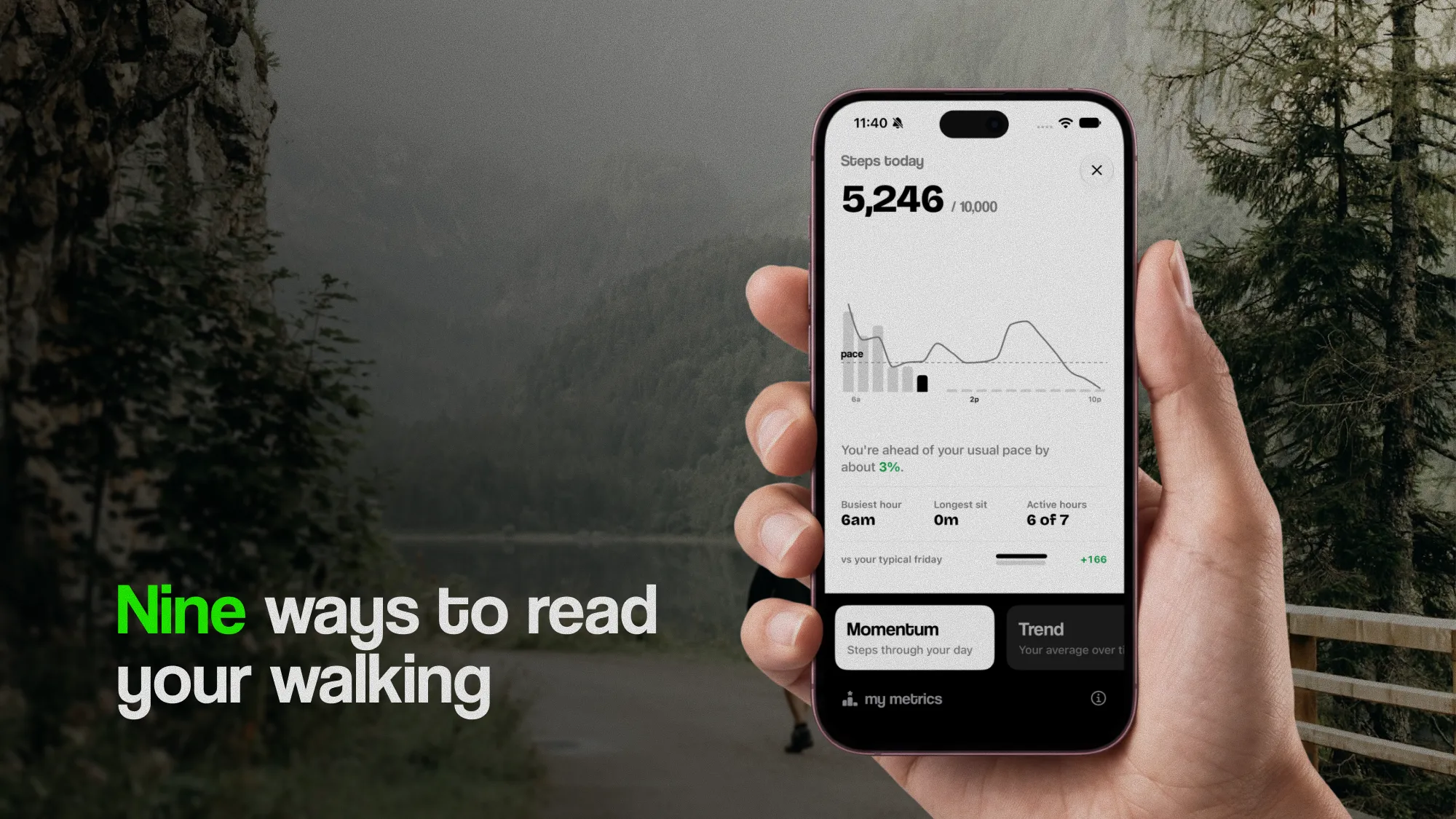
StepUp's Momentum screen lays out your steps hour by hour, and one of its numbers is your longest sit: the longest run of hours between 6 am and midnight with almost no steps (fewer than 100 in an hour). Beside it, active hours counts the hours you've taken 250 steps or more, so you can see how much of your day you were on your feet. Momentum is free and works out these numbers on your iPhone from Apple Health.
Because it counts in whole hours, the longest sit is a guide, not a stopwatch. A 45-minute stretch at your desk inside an otherwise busy hour won't show, and if your phone stays on the desk while you walk around, those steps aren't counted unless you wear an Apple Watch. Does your iPhone count steps in a bag? explains what your phone does and doesn't catch.
A good first goal is to bring your longest sit down to an hour or less on working days. Find where it falls, usually mid-afternoon at a desk or the evening on the sofa, and put your first break there. For how many steps to aim for across the day, see How many steps should you walk a day?
The short version
- Try not to sit for more than 30 minutes at a stretch, and an hour at most. The body's blood sugar and blood vessels start to notice within the first hour.
- Over a day, the risk of dying early rises past about 6 to 8 hours of sitting, and past 3 to 4 hours of TV.
- An hour or more of moderate activity a day can offset long sitting. Most people don't do that much, so breaks matter.
- The best-tested break is five minutes of easy walking every half hour. Walking does more than standing.
- On journeys over 4 hours, get up and walk every 1 to 2 hours to lower the risk of a blood clot.
Questions
Is sitting for 8 hours a day bad for you?
It's linked to a higher risk of dying early, mainly in people who aren't very active. In a study of more than a million people, about 60 to 75 minutes of moderate activity a day, such as brisk walking, removed the extra risk. Breaking your sitting up every 30 minutes helps too.
How often should you get up when sitting?
About every 30 minutes, for two to five minutes of easy walking. In a 2023 trial, five minutes every half hour made blood sugar spikes after meals 58% smaller and lowered blood pressure. Breaks once an hour lowered blood pressure but not blood sugar.
Is standing up enough to break up sitting?
It's better than nothing, but walking does more. A 2022 review of seven trials found that standing breaks lowered blood sugar a little, while easy walking breaks lowered both blood sugar and insulin by much more. A slow walk around the room is enough.
Does exercise undo sitting all day?
Partly, if you do plenty. In a study of over a million people, those doing about an hour or more of moderate activity a day had no extra risk from sitting 8 hours. That's about three times the guidelines, so for most people short breaks matter too.
How long can you sit on a plane before blood clots are a risk?
The CDC says journeys of more than 4 hours, by plane, car, bus or train, carry some risk of blood clots, though for most people it's very small. Move your legs often and walk around every 1 to 2 hours.
Sources
- Duran et al. (2023), Breaking up prolonged sitting to improve cardiometabolic risk: dose-response analysis of a randomized crossover trial, Medicine & Science in Sports & Exercise
- Columbia University Irving Medical Center (2023), news release on the Duran et al. walking-break trial
- Thosar et al. (2015), Effect of prolonged sitting and breaks in sitting time on endothelial function, Medicine & Science in Sports & Exercise
- Diaz et al. (2017), Patterns of sedentary behavior and mortality in U.S. middle-aged and older adults: a national cohort study, Annals of Internal Medicine
- Dunstan et al. (2012), Breaking up prolonged sitting reduces postprandial glucose and insulin responses, Diabetes Care
- Patterson et al. (2018), Sedentary behaviour and risk of all-cause, cardiovascular and cancer mortality, and incident type 2 diabetes: a systematic review and dose response meta-analysis, European Journal of Epidemiology
- Ekelund et al. (2019), Dose-response associations between accelerometry measured physical activity and sedentary time and all cause mortality: systematic review and harmonised meta-analysis, BMJ
- Ekelund et al. (2016), Does physical activity attenuate, or even eliminate, the detrimental association of sitting time with mortality? A harmonised meta-analysis of data from more than 1 million men and women, The Lancet
- Buffey et al. (2022), The acute effects of interrupting prolonged sitting time in adults with standing and light-intensity walking on biomarkers of cardiometabolic health: a systematic review and meta-analysis, Sports Medicine
- World Health Organization (2020), WHO guidelines on physical activity and sedentary behaviour
- CDC: Understanding your risk for blood clots with travel
Written by Dheeraj Kumar Sharma, who makes StepUp. How the guides are written.